Data quality in fulfillment: How to use advanced technologies for master data management

In e-commerce and retail logistics, it is not only people and technology that determine the efficiency of processes, but also relevant data. Every product that passes through the warehouse can have a “digital fingerprint” for its purposes – a record that can include, for example, dimensions, weight, identification codes, and photographs. It is the quality of this data that often determines the speed, reliability, and overall efficiency of fulfillment.
When working with data, an incorrectly entered dimension, missing EAN, or inaccurate weight may seem like a minor issue at first glance. In practice, however, even a small deviation can cause a chain of inaccuracies across related warehouse processes, from goods receipt to shipment to the customer.
What is master data, why is it so important, and how can its management be automated using technologies such as cubiscan? We will explain this in the following paragraphs and also provide some practical examples.
What is master data and why does it matter?
In order for a warehouse management system (WMS) to function reliably, it needs high-quality master data. In logistics, this refers to a set of basic information that describes each product.
This includes, for example:
- SKU (unique product code);
- EAN (barcode for identification);
- inventory management method (FIFO / FEFO);
- dimensions and weight;
- product photos and description;
- other attributes, such as color, packaging type, or storage conditions, if applicable.
It is precisely this data that helps with fulfillment handling. It determines which picking box to place the product in during picking, which packaging to choose, how to optimize transport, and how much space will be needed for storage.
The risk arises in situations where data is incomplete or inaccurate. The error is chained and manifests itself in each subsequent operational phase, which affects the quality of operation:
- goods are stored in the wrong storage location;
- an unsuitable box is chosen for packaging;
- the carrier charges different rates due to differences in weight;
- and other unnecessary complications.
We know from experience that these seemingly minor details are often a source of complications – in the worst case, errors; in the better case (if we discover them), extra work. Conversely, accurate and consistent data enables all processes to run smoothly and efficiently.
Data measurement and management: From manual entry to automation
Data quality often does not begin in the warehouse, but rather on the client’s or manufacturer’s side. Product information can flow into our warehouse from various e-shop platforms or ERP systems, and it is not always complete or accurate. Missing weight, estimated dimensions, or incorrectly entered EAN codes can cause problems across the supply chain.
That is why it is crucial to verify data immediately after it is received at the warehouse, i.e., at the moment when we physically encounter the goods. It is then that missing data can be added or corrected so that it is recorded in the warehouse system and warehouse staff work only with correct and verified information.
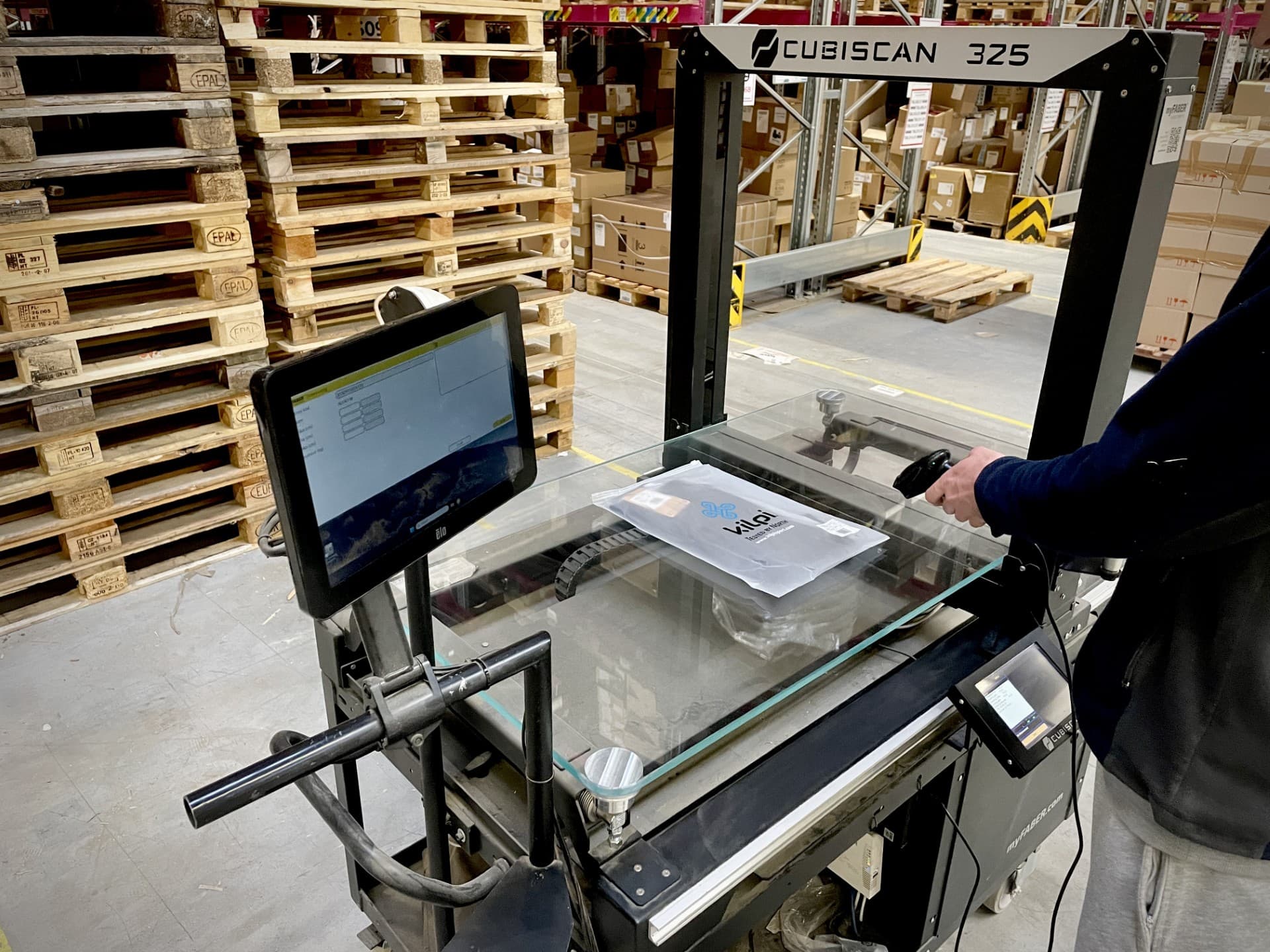
Today, this task is performed by automated measuring systems such as cubiscan. Within seconds, it can accurately provide the necessary data, such as weight, and also take a photo of the product.
Cubiscan in practice: How it ensures data quality
Cubiscan is an automated measurement system used to quickly and accurately obtain key product data. It combines several technologies into one device:
- laser sensors for precise measurement of product dimensions;
- weighing platform for determining weight;
- photo module for taking a current photo of the product, which serves not only for documentation but also for visual checks.
This gives the warehouse system a complete, accurate, and verified digital profile of each unique product in a matter of seconds. The data measured in this way eliminates inaccuracies that can arise, for example, from external inputs.
Note: At Skladon, we use cubiscan primarily when receiving new products and checking data for existing items. The measured values are automatically transferred to the MySkladon client application, where they are linked to the inventory and simultaneously sent to the WMS system for managing other warehouse operations.

The result is not only greater efficiency and reliability of fulfillment services, but also a solid base for measuring data quality and a basis for further optimization of warehouse processes.
Data quality metrics: How to tell if data is “okay”
Even though products are accurately measured upon receipt and data is supplemented, it is good to have a control system in place that allows you to monitor their ongoing quality. Five main metrics are most commonly used to evaluate data quality:
- completeness;
- accuracy;
- consistency;
- timeliness;
- understadability.
The combination of the above metrics helps to reveal whether the data in the warehouse is not only technically correct, but also practically usable for everyday operations.

Completeness
Completeness means that all key information is available for each product – from the EAN code to dimensions, weight, and photos.
If any of this information is missing, there is a risk of errors in subsequent processes. For example, missing dimensions can lead to the selection of incorrect packaging materials.
Accuracy
Accuracy ensures that data corresponds to reality.
In fulfillment practice, accuracy is essential: deviations in dimensions or weight can lead to incorrect packaging, exceeding the capacity of transport units, or errors in calculating transport costs.
Consistency
Consistency means that the same data is uniform across all systems.
For example, if the identification code (SKU) or EAN differs between systems, the product may end up in the wrong order, be incorrectly stocked, or not be found at all during picking.
Timeliness
Timeliness ensures that data always reflects the current status of the product.
In fulfillment, this is essential, for example, when updating weight or dimensions, because outdated data can cause incorrect packaging selection or incorrect determination of storage locations.
Understadability
Understadability ensures that data is clear and easy to interpret for individual members that handle products.
In the warehouse, this fact is reflected in every step – from receiving, where the worker must correctly identify the item, through picking, where it is crucial to find the product quickly and clearly, to packaging and shipping, where clear data prevents problems arising on the way to the customer.
Data quality as the basis for effective fulfillment
Proper data quality is key to reliable warehouse operations, whether focused on e-commerce or retail. Complete, accurate, consistent, up-to-date, and understandable product information affects every warehouse process, from receiving and storage to picking and packing to shipping to the end customer.
Technologies such as cubiscan enable automatic verification and updating of data upon initial contact with goods, creating a unified digital profile for each SKU that is automatically transferred to all IT systems. At our distribution center, we use the information measured and verified in this way across our entire intralogistics operation.
Properly managed data quality thus supports efficient, reliable, and scalable fulfillment, minimizes the risk of errors, and ultimately contributes to customer satisfaction and long-term business growth.
